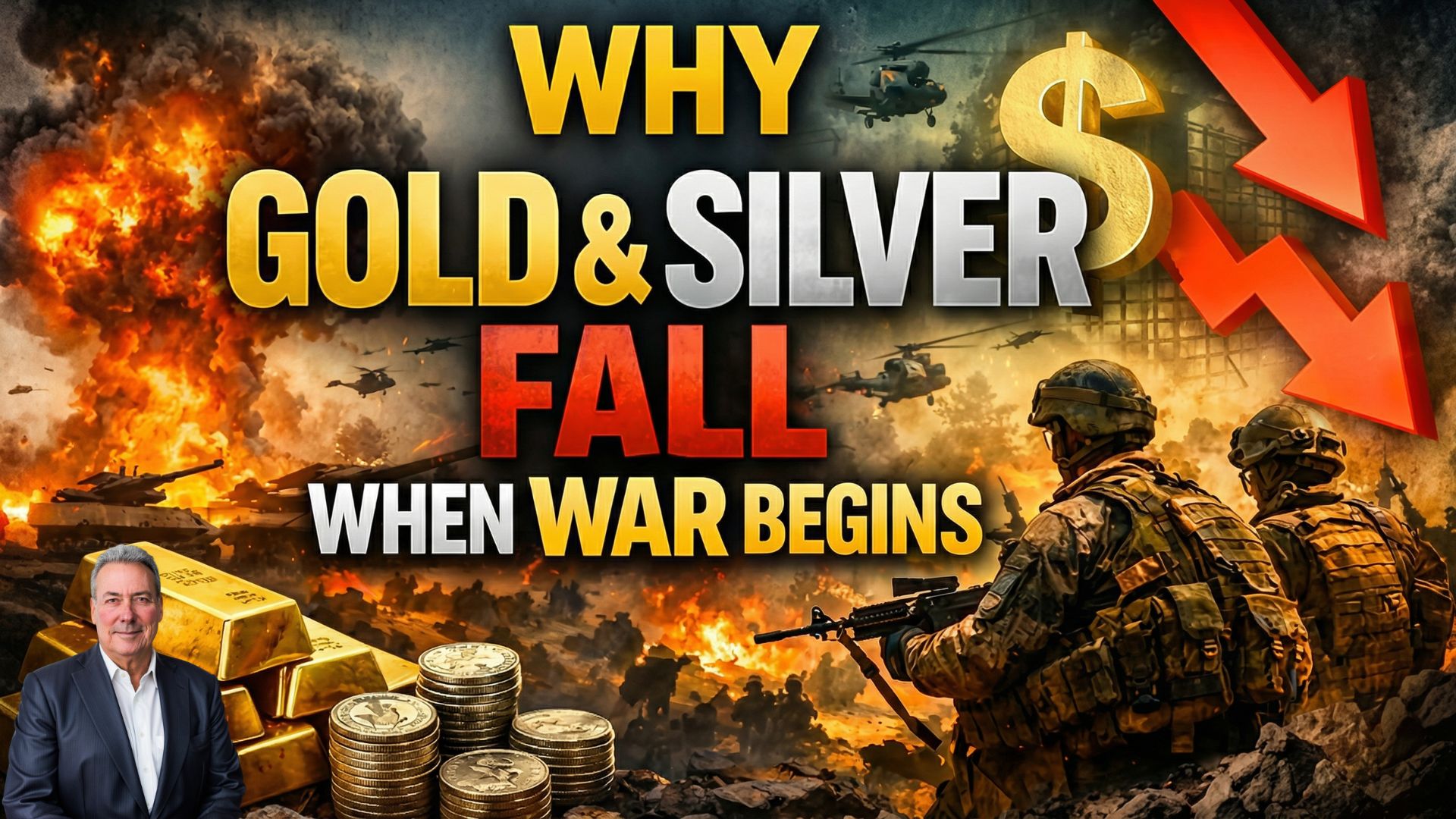
One of the more confusing moments for investors in the precious metals sector occurs when geopolitical conflict erupts and gold and silver fall instead of rallying. Many people instinctively believe that war should send safe-haven assets straight up. When the opposite occurs, it casts doubt on the metals themselves. The mainstream financial press typically explains these declines with familiar reasoning: a stronger U.S. dollar, rising interest rates, profit-taking after a strong rally, or leveraged funds unwinding positions. Those factors can certainly play a role. But they do not fully explain the pattern we have seen repeatedly over decades.
The deeper reality is that markets tend to price uncertainty before events occur. Gold often rises in anticipation of conflict, during periods when tensions escalate, and the outcome is unclear. Investors seek insurance against the unknown, and the metals benefit from that uncertainty premium. By the time a war actually begins, however, much of that fear has already been priced into the market. When the shooting starts, uncertainty in some sense decreases. Investors suddenly have a defined event rather than an unknown one. That shift can cause gold and silver to pull back, even though the underlying geopolitical situation has clearly become more serious.
History provides several examples of this pattern. Before the first Gulf War in 1990, gold rallied strongly as the world worried about the implications of Iraq’s invasion of Kuwait. Yet when Operation Desert Storm began in January 1991, gold declined rather than surged. A similar pattern occurred in 2003 ahead of the Iraq War. Gold rose during the buildup to the invasion but weakened once the military campaign began. More recently, in early 2022, gold surged above $2,000 as tensions between Russia and Ukraine escalated. Yet after the invasion officially began, gold initially corrected rather than launching an immediate, sustained rally.
This counterintuitive reaction stems from several structural forces that operate in global markets. One of the most important is liquidity. When war breaks out, markets often experience a sudden rush for cash. Equity markets may drop, volatility increases, and leveraged investors may face margin calls. In that environment, participants sell what they can rather than what they want to sell. Gold and silver are among the most liquid assets in the world, so they often serve as a source of liquidity during periods of stress. The result can be temporary selling pressure, even though the long-term reasons for owning the metals have not changed.
Currency dynamics also play a role. During the initial stages of geopolitical crises, capital often flows into U.S. Treasury securities and the U.S. dollar. A stronger dollar tends to put pressure on dollar-denominated commodities, including precious metals. At the same time, other commodities may react differently depending on how the conflict affects supply chains. Energy markets, for example, often move higher during war because oil supply routes and production infrastructure may be directly threatened. Oil is reacting to potential physical shortages. Gold, by contrast, is responding primarily to monetary conditions and financial liquidity.
Understanding this sequence helps clarify what often appears to be a contradiction. Gold and silver do act as safe-haven assets, but their role is more nuanced than many assume. They tend to perform best during periods of rising uncertainty and deteriorating monetary confidence. The moment a conflict begins is often not the peak of market uncertainty. Instead, it can trigger a short-term adjustment as traders unwind positions and financial markets search for liquidity.
Over the long term, however, the consequences of war frequently reinforce the case for precious metals. Wars are expensive. They tend to expand government deficits, increase debt issuance, and often lead to more accommodative monetary policy. Energy shocks and supply disruptions can also contribute to inflationary pressures. Those broader economic effects typically develop over months and years, not days. It is during that later phase that gold and silver often reassert their role as monetary hedges.
For investors, the key lesson is that markets rarely move in straight lines or follow simple narratives. The expectation that “war equals higher gold prices immediately” overlooks how financial markets actually function. Gold often rises on the fear of conflict, may decline briefly once the conflict begins, and then strengthens again as the economic consequences unfold.
What appears to be a failure of the safe-haven trade is often just the market transitioning from one phase of the cycle to another. Understanding that dynamic can help investors maintain perspective during periods when headlines and price movements seem to contradict each other.
Market Analysis/Investing/Trading Methods At TheMorganReport.com | http://www.themorganreport.com/join
Let My Passion Create Your Wealth...
I’ve Been Helping My Subscribers Weather the Current Economic Mess. Now I Invite You to Join My Growing Circle of Successful Investors.
The Morgan Report is all about YOU and how you can build and preserve Wealth for generations to come. We know it can sometimes seem a daunting task to protect your assets and preserve or grow your wealth. Over 15 years ago, a small group of us started The Morgan Report and formed an exclusive membership organization to promote personal freedom, an honest money system, free market wealth accumulation, and asset protection.
Thus was born The Morgan Report – since then we’ve helped 11,000-plus members scattered over the globe in every continent and over 100,000+ e-newsletter subscribers have read our weekly e-newsletter — This Week’s View from The Morgan Report.
Through our publication, The Morgan Report, we provide you with ways to achieve greater financial security and wealth in all sorts of environments.
Learn more and become an insider for The Morgan Report, click the button below…